Oct 14, 2026Industry News
Open Display or Dust-Protected Garage? Choosing the Best Setup for Diecast Cars
Compare open displays and dust-protected garages for diecast cars. Learn about dust protection, accessibility, display space, and choosing the right 1:64 garage.
Building a diecast model car collection is exciting, but deciding how to display it can be just as important as choosing the cars themselves.
Some collectors prefer an open display where every car is easy to access and rearrange. Others prefer a garage with a dust cover to keep their collection looking clean and organized.
Both options have their advantages. The right choice depends on the size of your collection, your available space, and how you like to display your cars.
In this guide, we will compare open displays and dust-protected garages to help you choose a setup that works for your diecast collection.
1. What Is an Open Display?
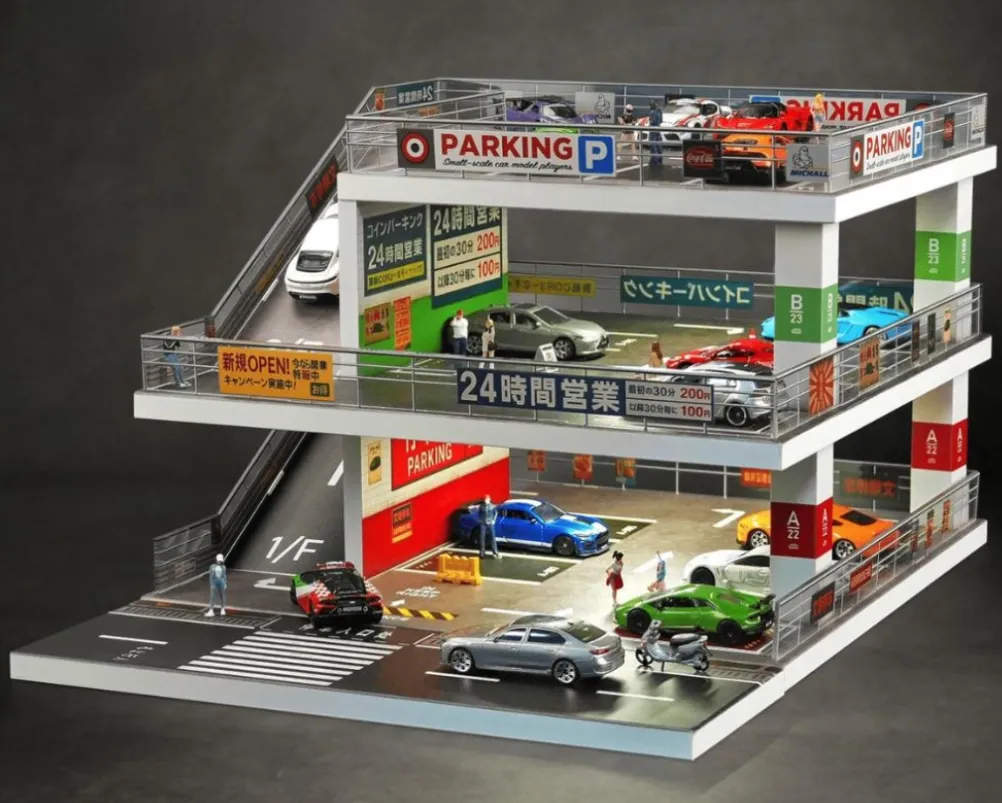
An open display is a setup without a front cover or enclosed structure. It may include a miniature parking garage, display shelf, street diorama, or workshop scene.
The main advantage is accessibility. You can easily pick up a car, change its position, or rearrange the entire scene whenever you want.
Open displays are also suitable for collectors who enjoy photographing their vehicles. Without a front cover, there is no additional surface between the camera and the miniature scene, which can make taking close-up photos more convenient.
Another advantage is flexibility. You can add new cars, move accessories, or change the layout without needing to open or remove a cover.
However, open displays leave cars and accessories exposed to dust. Depending on the display location, you may need to clean the collection more frequently.
2. What Is a Dust-Protected Garage?
A dust-protected garage is a miniature parking or display structure that includes a cover designed to help reduce dust settling directly on the cars.
Some designs feature a sliding front cover. This allows collectors to view their cars while providing an additional layer of protection.
For collectors who display multiple vehicles in one place, this type of garage can offer a more enclosed and organized appearance.
A covered garage may be especially useful when the collection is displayed in a living room, bedroom, office, or retail environment where keeping the display tidy is a priority.
However, a cover does not make a display completely dustproof. Dust may still enter through openings, and occasional cleaning will remain necessary.
It is also worth checking how the cover opens and how much access it provides before choosing a particular design.
3. Open Display vs. Dust-Protected Garage: Key Differences
Here is a simple comparison to help you decide.
Feature | Open Display | Dust-Protected Garage |
|---|---|---|
Access to cars | Easy to reach and rearrange | Depends on the cover design |
Dust protection | Cars remain exposed | Helps reduce direct dust accumulation |
Photography | Convenient for close-up photos | Reflections may occur on the cover |
Display appearance | Open and accessible | More enclosed and organized |
Adding accessories | Easy to adjust the layout | Depends on available access |
Cleaning | May require more frequent cleaning | Still needs occasional cleaning |
Best suited for | Collectors who often rearrange cars | Collectors who prefer a more protected display |
Neither option is automatically better. The best setup depends on how you use your collection and what matters most to you.
4. How Many Cars Do You Need to Display?
The size of your collection can influence your choice.
If you own only a few diecast cars and enjoy changing their positions regularly, an open display may be all you need.
As your collection grows, however, keeping everything organized can become more challenging.
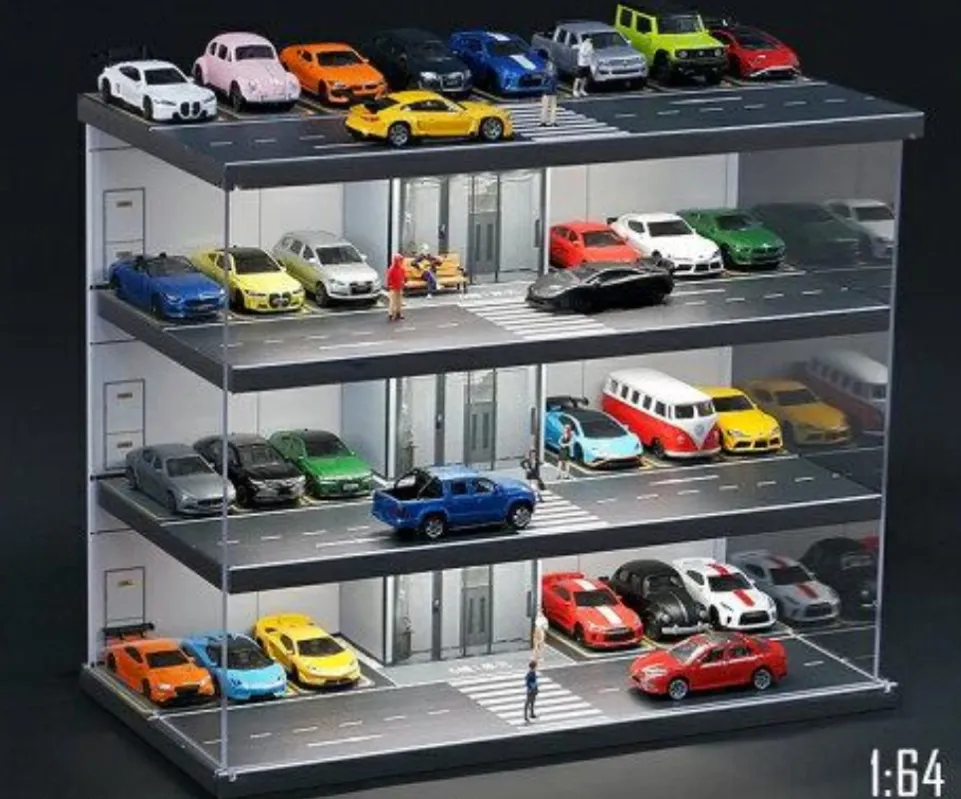
A multi-level parking garage can help you use vertical space more efficiently, allowing you to display multiple vehicles within a smaller footprint.
For collectors who want to display many cars while keeping the scene organized, a multi-level garage with a suitable dust cover may be worth considering.
Before purchasing, check the overall dimensions, parking space sizes, and the number of cars the structure can accommodate. Vehicle dimensions can vary even among models labeled as 1:64 scale.
5. Think About Your Display Location
Where you plan to display your collection is another important factor.
Bedroom or living room
If your collection is part of your home decoration, a covered garage may help keep the display looking tidy between cleaning sessions.
Office or desk
An open display can work well when space is limited and you want to move cars around easily. A compact covered garage may be a better fit if you prefer a more organized setup.
Dedicated hobby room
Collectors with a dedicated hobby space have more flexibility. You can combine open parking scenes, workshop dioramas, and covered garages to create different display areas.
Retail shop
For a retail environment, the choice depends on the purpose of the display. Open scenes make it easy for customers to view details and allow staff to rearrange products, while covered displays can help keep demonstration pieces cleaner between maintenance sessions.
6. Do Dust Covers Affect the Viewing Experience?
A dust cover provides an extra barrier, but it can also affect how you view and photograph your cars.
Transparent covers may produce reflections under certain lighting conditions. This can be noticeable when taking close-up photographs or viewing the cars from particular angles.
If photography is an important part of your hobby, consider the transparency of the cover, the lighting in your display area, and the available viewing angles.
For everyday display, a sliding front cover can offer a practical balance between visibility and access.
It is also helpful to check the cover's movement and fit when evaluating a product. A design that is easy to open and close will make routine access more convenient.
7. Can You Combine Open and Covered Displays?
You do not necessarily have to choose only one display style.
Many collectors can benefit from using both.
For example, a covered parking garage can hold the main collection, while a smaller open workshop scene can be used to showcase selected vehicles and accessories.
This arrangement allows you to keep some cars in a more protected display while leaving others accessible for photography, rearranging, or closer inspection.
You can also use an open workshop scene to highlight miniature details such as mechanic figures, tire racks, car lifts, and tool cabinets.
When combining different displays, consider their scale, dimensions, and visual style so that they work well together.
8. What Should Buyers Check Before Choosing a Garage?
Whether you prefer an open or covered setup, there are several practical points to review before purchasing a miniature garage.
- Vehicle compatibility: Check parking space dimensions and entrance clearance.
- Overall size: Measure the space available for the display.
- Cover design: If a cover is included, check how it opens and how easily you can access the cars.
- Material and finish: Review product photos and specifications to understand the design and construction.
- Assembly requirements: Check whether assembly is needed and whether instructions are provided.
- Accessory compatibility: Make sure there is enough space for figures, tire racks, and other miniature equipment if you plan to add them.
If you are buying online, detailed product photos and measurements can help you make a more informed decision. When possible, examining a sample in person can provide a clearer idea of the product's materials, finish, and usability.
9. What Should Diecast Retailers Consider?
For diecast model car retailers and hobby stores, offering different display styles can help meet the needs of different collectors.
Some customers may prefer an open garage because they frequently rearrange their cars. Others may be more interested in a covered parking garage that helps keep their collection organized.
A balanced product selection could include:
- Open parking garages for flexible displays.
- Multi-level garages for collectors with larger collections.
- Covered garage designs for customers who prefer additional dust protection.
- Workshop accessories such as mechanics, miniature tires, tire racks, and car lifts.
Retailers can also consider testing several designs before committing to larger quantities. Comparing different models can help buyers assess product details and decide which options best suit their customers.
Mixed-model sample orders can be a practical way to evaluate different styles in one order.
Explore Parking Garages and Diorama Accessories from us
We offers miniature parking garages, garage and workshop scenes, street dioramas, and accessories for diecast model car displays.
Our range includes different designs for collectors and businesses looking for ways to display miniature vehicles. Depending on the model, available features may include multi-level layouts and sliding front dust covers.
We also support mixed-model sample orders, allowing buyers to evaluate different designs before deciding which products best fit their collection or retail range.
Contact SUNDOR to explore available models, request product details, and discuss sample options.
Final Thoughts
Open displays and dust-protected garages both have a place in diecast collecting.
An open display is a good choice for collectors who value easy access, frequent rearrangement, and convenient photography. A covered garage may suit those who prefer a more organized display and want to reduce dust settling directly on their cars.
Before choosing, consider your collection size, available space, display location, and how often you handle your vehicles.
The goal is not simply to find a place for every car. It is to create a display that suits your collection and makes it enjoyable to look at every day.